Clue Challenges
The Crisis of Modern Quiz Games
Today, more and more traditional quiz competitions are facing a crisis few could have predicted: the unmonitored misuse of technology threatens to undermine the very foundation of quiz culture. Where knowledge, memory, logical reasoning, and friendly competition once took center stage, we now see a quiet race against Google and AI tools. When every participant carries a near-instant “all-knowing” assistant in their pocket, the boundaries of fair play blur, and the very purpose of quizzing begins to erode.
The problem is no longer marginal. Hosts of pub quizzes, company team challenges, and even family game nights report the phenomenon spreading like wildfire: more and more participants openly google answers or ask them from AI—often so discreetly that cheating is nearly impossible to prove. As a result, question difficulty, the effort put into designing the quiz, and the host’s expertise all go to waste.
When winning no longer reflects what you know, but simply how quickly and boldly you can sneak a glance at your phone, the essence of quizzing is lost. Fair competition collapses, motivation drops, and a genuinely shared experience turns into a contest of technological shortcuts.
In short: unless something changes, the traditional quiz is at risk of disappearing—not because people lack knowledge, but because knowledge is now too easily within reach.
So, What’s the Fix?
Team Action Zone uses several different methods in its activities to ensure that internet searches or AI tools provide little to no advantage—unlike in traditional quiz questions where such shortcuts can easily break the game.
One of our most effective and highly engaging methods is the “clue challenge.” In these challenges, teams receive unique clues on multiple mobile devices at short intervals. By studying, comparing, and discussing these clues, the team must work together to uncover the common answer as quickly as possible.
We can add clue challenges to any of our activities, based on whatever themes the client prefers—for example, “Famous Movies.”
Other example themes include: cities, world cuisines, international cocktails, historical events, well-known bands, famous people, notable athletes, well-known sports teams, ballets & operas, and many more.
Key Benefits of the Clue Challenge Format
Beating Artificial Intelligence
In clue challenges, team members receive a rapid stream of unique, device-specific clues on their mobile phones. Each clue must be communicated to the rest of the team immediately. Sharing one’s clues, combining information, and discussing interpretations quickly take up all attention and available time.
Because new clues appear simultaneously on multiple devices and at a fast pace, feeding the complete set of information into an AI tool is simply unrealistic. The clues arrive too quickly and from too many sources for anyone to compile them into a single, coherent prompt before the game has already moved on. This forces teams to rely on genuine collaboration and rapid in-person communication rather than external information sources.
Difficulty Always Just Right
In clue challenges, the first clues are intentionally difficult, vague, and only minimally revealing. They are designed so that only a true expert could even attempt to guess the answer based on a single clue.
As time goes on, the nature of the clues changes. They gradually begin to reveal more concrete information, clearer details, and eventually almost identifying facts. The final clue practically gives away the answer.
In traditional quizzes, difficulty is based on whether a participant can figure out the answer at all. In clue challenges, this shifts to time-based skill. Most participants will eventually find the right answer, but those who make the connection faster earn more points. This way, the challenge remains—but it becomes fairer, more dynamic, and more engaging for everyone.
Engaging Everyone
Each team member receives their own set of completely unique clues on their mobile device, appearing for example every 15 seconds. Every clue is part of a larger whole, but none of them reveals enough on its own. To get the most out of the clues, each member must share their clues with the team and listen just as carefully to what others have discovered.
This quickly creates a highly active and intense atmosphere of discussion. Team members read out their clues as they arrive, pick up meaningful details from others’ clues, and collectively assemble a puzzle that becomes clearer moment by moment. No one can sit on the sidelines, because every clue — and every team member — is essential for forming the full picture.
The result is a fast-paced, energetic, and collaboration-driven gameplay experience where everyone is fully involved and the team’s success depends on the contribution of each member.
Wide-Ranging Variety
The nature of clue challenges makes it possible to use an enormous range of themes. Clue challenges can be created for virtually any topic imaginable.
In addition, instead of a single traditional quiz question, a clue challenge might include eight unique clues delivered across four different devices — a total of 32 unique clues for just one question. This format is far more diverse, engaging, and enjoyable for participants than a standard question-and-answer setup.
An Example of a Clue Challenge: Who's the Sports Figure?
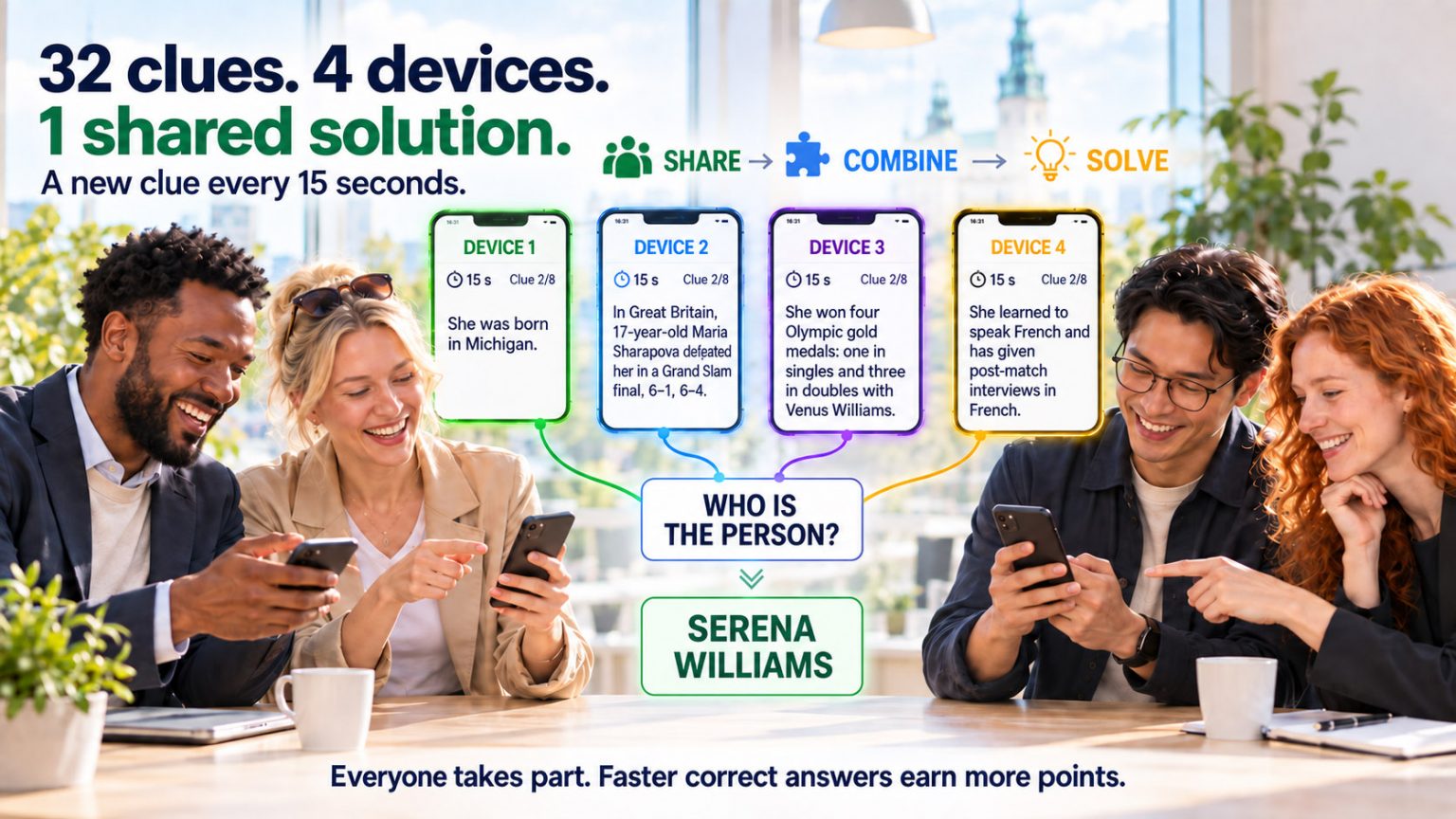
The actual clues per mobile device
Mobile device 1
Her sport is played on a rectangular court divided by a net, with players striking a felt-covered ball using rackets.
She was born in Michigan.
Her family moved to Compton, California, when she was young, and she practised on local public courts.
Her parents, Richard Williams and Oracene Price, initially coached her themselves.
She later trained in Florida under coach Rick Macci but continued to follow her father’s unconventional development plan.
She made her professional debut at 14, losing in the qualifying round of a tournament in Canada.
At 16, she defeated established stars Mary Pierce and Monica Seles during a breakthrough tournament.
Her older sister Venus also became a world-class professional tennis player.
Mobile device 2
In the United States, Venus Williams defeated her 6–2, 6–4 in their first major singles final.
In the United Kingdom, 17-year-old Maria Sharapova defeated her 6–1, 6–4 in a major final.
In 2012 in the United Kingdom, she overcame Agnieszka Radwańska 6–1, 5–7, 6–2 to secure her fifth title on the grass courts.
In 2015 in France, she defeated Lucie Šafářová in three sets to claim her 20th major singles championship.
In 2015 in the United States, Roberta Vinci produced a major upset, ending her attempt to win all four major singles titles in the same calendar year.
In 2018 in the United States, Naomi Osaka defeated her 6–2, 6–4 in a controversial final involving several disputes with the umpire.
In 1999 in the United States, she defeated world number one Martina Hingis to win her first major singles title at only 17.
In 2017 in Australia, she defeated Venus Williams without dropping a set to win her 23rd major singles title—while pregnant.
Mobile device 3
She compiled a career singles record of 858 victories and 156 defeats.
She won 73 singles titles, including five year-end championships and a record 23 WTA 1000 titles.
She became the oldest woman to hold the world number-one ranking, at 35 years and 230 days.
She spent 319 weeks at number one, including 186 consecutive weeks—a record she shares with Steffi Graf.
She twice held all four major singles titles simultaneously, an achievement known as the “Serena Slam.”
She won 39 major titles: 23 in singles, 14 in women’s doubles and two in mixed doubles.
She won four Olympic gold medals—one in singles and three alongside Venus Williams in doubles.
Her 23 major singles championships are the most won by any woman during the Open Era.
Mobile device 4
She studied fashion design and later launched clothing, jewellery and beauty brands.
She learned to speak French and has conducted post-match interviews in the language.
She and Venus Williams became minority owners of the Miami Dolphins, making them the first Black women to own a stake in an NFL team.
She founded Serena Ventures, an investment company supporting innovative businesses and underrepresented founders.
Her charitable work has included helping establish schools in Kenya and serving as a UNICEF Goodwill Ambassador.
After experiencing life-threatening complications following childbirth, she began speaking publicly about maternal healthcare and the risks faced by Black women.
She and Venus served as executive producers of King Richard, the film about their father and their family’s journey.
She is married to Reddit co-founder Alexis Ohanian, and their daughters are named Olympia and Adira.